Field Notes
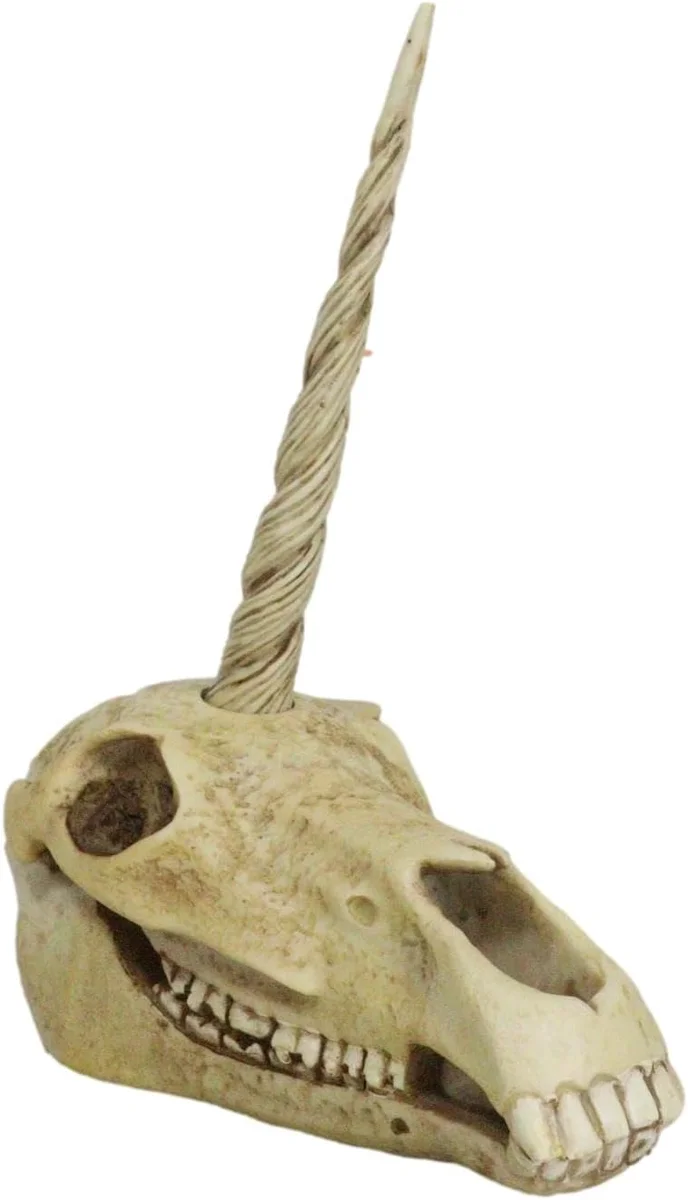
An Ebros statue presenting a unicorn skull—the mythical horse rendered as archaeological specimen, merging fantasy with memento mori. The piece frames the impossible (a creature that never lived) as the skeletal real, positioning it as a collected artifact rather than a literal natural-history piece. Marketed as educational novelty (gift for archaeologists, excavation adventurers), it functions as both collectible prop and genuinely odd domestic object: something inherently cute extracted as something inherently dark.
The classification lists it as resin, and that is about where confirmed detail ends. Exact dimensions, weight, finish, hardness, whether the paint is applied by hand or by machine, and how well it holds up to long display are all unstated. Confirm scale and finish before buying. The concept carries it regardless. A fossil is proof that something lived, and dressing a unicorn in that language is a small, dry lie, a museum placard for an animal that never existed. That deadpan commitment is what keeps it from reading as a children's toy and lets it sit among real specimens without apology.
Where it lives
Give it a museum context: a glass cloche, a small brass or chrome easel, or a shelf with a typed index card beside it. Pair it with pink crystals, a pastel-glazed dish, or iridescent glass, so the specimen sits against the candy-colored mythology it is quoting. It also holds its own beside real natural-history pieces, mixed in with shells, pinned insects, or a geode slice. Skip glitter and rainbow props; the joke works best when the presentation stays dead serious.
Who it’s for
For collectors of fake natural history, unicorn fans with a dark streak, and as a gift for someone who studies archaeology or paleontology and would appreciate the joke. Pass if you need confirmed dimensions for a specific shelf, want a hand-finished art piece with known provenance, or are shopping for a young child, since the durability of resin details under handling is not stated.
Before you buy
What to confirm on the current listing before it goes in the cart.
- Confirm height, length, and weight on the Amazon page, since the listing gives no dimensions.
- Look at product photos to judge finish: aged and textured or smooth and glossy.
- Check whether the horn is a separate attached piece, which affects how fragile it is.
- If it is resin, dust with a soft dry brush and keep it out of hot direct sun.